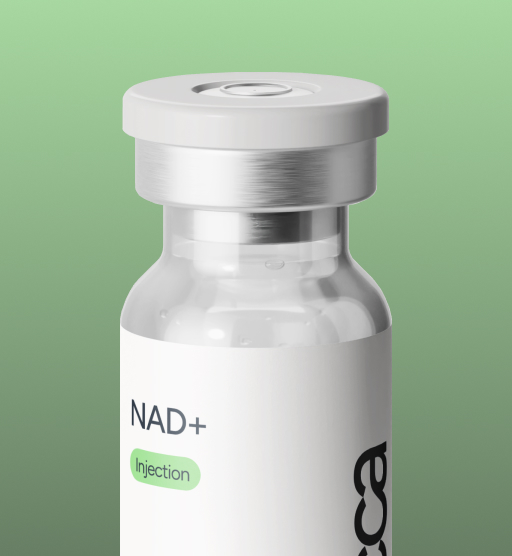

When comparing NAD+ injections with IV drips, start with three separate questions: What exactly is being administered? What will the complete service cost? And what evidence supports the outcome you want? A detailed answer to one question does not automatically answer the others.
An IV delivers into a vein; an intramuscular shot delivers into muscle, and a subcutaneous shot delivers beneath the skin. Those are administration routes, not a ranking of how much NAD+ reaches a particular cell. [1]
First, clarify what “NAD+ injection” means
Ask the provider to name the product and write out the route. “Injection” is too vague for a useful comparison: IM and SC are not synonyms, and an IV drip introduces the solution into a vein over time. A quote for one route should not be treated as a substitute for another. [1]
Use the exact product name in your notes. If the offer involves NR, NMN, a vitamin blend, or other added ingredients, ask the clinician to explain what is different; do not assume that every service advertised around NAD+ is the same product. Keep that answer alongside the price quote.
Key Takeaways
- Specify the formulation and route before comparing offers.
- Compare the total planned cost and full appointment commitment, not only a session price or administration time.
- The small human IV studies discussed below do not establish that IV NAD+ is better than IM or SC NAD+ for patient outcomes. [2] [3]
- Compounded drugs do not receive FDA premarket approval review; product quality is a separate safety question. [5]
Cost: compare written totals, not headline prices
This guide does not assign a national price range or promise that one route is cheaper. Instead, ask each provider for an itemized quote covering the same period. Label a one-time visit, a shipment, and a multi-visit package clearly; otherwise, the totals are not answering the same question.
- Product: exact formulation, route, amount supplied or administered, and number of planned visits or shipments.
- Clinical care: initial evaluation, administration, monitoring, and any follow-up the provider says is required.
- Additional charges: any required testing, supplies, shipping, membership, or repeat consultation. Ask which are mandatory.
- Terms: expiration, cancellation, refund conditions, and what happens financially if the clinician recommends stopping.
- Your total: request the actual out-of-pocket amount. Verify any reimbursement claim with the relevant payer rather than assuming coverage.
Write down the total before considering a discount. If one proposal includes repeated appointments and another includes only the product, ask what clinical support is missing from the second quote. This is a budgeting checklist, not a recommendation for a particular number of sessions.
If you are comparing a Yucca option, review how Yucca’s care process works and ask which parts apply to your proposed treatment. That process page is not evidence that a particular NAD+ route works better.
Time: ask about the whole visit
Separate administration time from evaluation, setup, observation, travel, and follow-up. Ask how much time to reserve for the first visit and later visits, what could extend an appointment, and whether the quoted duration includes monitoring. Do not schedule around a number that describes only one step.
A 2019 pilot used six-hour infusions; a 2026 study reported a mean of 97 minutes with substantial variation. These are study-specific observations, not appointment promises or schedules to copy. [2] [3]
For a proposed shot, request the same full-service breakdown. If administration outside a clinic is being proposed, ask who determines suitability, provides training, and handles problems. A shorter time commitment by itself cannot answer whether the treatment is worthwhile.
What actually reaches your cells? What the studies can tell us
A 2019 randomized pilot studied eight men receiving NAD+ IV and three receiving saline. Investigators tracked plasma and urine measures during a six-hour infusion and through hour eight. Early plasma findings could reflect uptake and/or metabolism; they did not establish how much intact NAD+ entered a target tissue. This small, short study did not compare IM or SC injections or demonstrate anti-aging benefits. [2]
A 2026 retrospective clinic study compared six NAD+ IV clients with eight NR IV clients. All six NAD+ clients reported moderate-to-severe infusion symptoms, including gastrointestinal discomfort, increased heart rate, or chest pressure; these ceased when the infusions ended. Insufficient sampling prevented assessing blood NAD+ changes. There was no placebo group, all authors worked for the provider, and the study did not compare IV with IM or SC NAD+. [3]
Neither pilot establishes target-cell delivery or better outcomes than NAD+ shots. That uncertainty is not proof that cellular uptake never happens. [2] [3]
Ask for research on the exact formulation, route, and outcome being offered. An explanation of where a needle goes should not stand in for an explanation of what benefit you can reasonably expect.
Safety: the preparation matters as well as the route
FDA has warned about food-grade NAD+ ingredients being used in sterile products without appropriate processing. It has received reports after NAD+ injectables of severe chills, shaking, vomiting, and fatigue, sometimes requiring medical treatment; the agency says these reactions are consistent with excessive endotoxins. These reports do not provide a side-effect rate or mean every reaction has the same cause. [4]
Separately, FDA explains that compounded drugs are not FDA-approved: the agency does not review their safety, effectiveness, and quality before marketing. Compounding can meet individual medical needs, but contamination or incorrect potency can cause serious harm. A prescription or a licensed pharmacy is not the same as FDA approval of that compounded product. [5]
Before proceeding, ask who prescribes and prepares the product, how its suitability for sterile administration is established, what monitoring is provided, and whom to contact for an adverse reaction. These are questions for the treating team, not a home checklist for certifying a product yourself.
You can also read Yucca’s NAD+ safety information before a care discussion. It describes Yucca’s patient-facing information; it does not replace your clinician’s assessment or independent evidence about a treatment.
Questions worth answering before you decide
- What specific problem or goal are we addressing, and what other explanations or options should be considered?
- What human evidence supports this exact product and route for that goal—not merely a change in a laboratory marker?
- What would count as a worthwhile result, how would we assess it, and when would we reconsider the plan?
- What are the foreseeable risks and uncertainties, and what is the plan if I feel unwell?
- What is the complete financial and time commitment before I agree?
It is reasonable to pause if those answers are unclear. A comparison becomes more useful when the expected benefit, uncertainty, practical burden, and stopping plan are all written down together.
Frequently Asked Questions
What should I bring to a comparison appointment?
Bring the written offers, the exact product names and routes, your goals, and your questions. Ask the clinician to separate established findings from uncertain benefits and practical preferences.
Are NAD+ shots always cheaper than IV drips?
Do not assume so from an advertised session price. Compare the written total for the proposed product, clinical services, additional charges, and planned period. Ask what each quote excludes.
Is compounded NAD+ FDA-approved if a clinician prescribes it?
No. Prescribing a compounded drug does not make it FDA-approved. Ask the clinician to explain the rationale, uncertainty, and quality safeguards for the specific product. [5]
The bottom line
Start with the clinical reason, then compare the exact product, evidence, full cost, and time commitment. Neither a more elaborate appointment nor a lower price settles the question of value. The most useful next step is a clear conversation with the treating clinician—not choosing by route alone.
This article provides general education and is not individualized medical advice.
References
- U.S. Food and Drug Administration. Route of Administration. CDER data standard C-DRG-00301, version 004. Accessed September 8, 2026.
- Grant R, et al. A Pilot Study Investigating Changes in the Human Plasma and Urine NAD+ Metabolome During a 6 Hour Intravenous Infusion of NAD+. Front Aging Neurosci. 2019;11:257. doi:10.3389/fnagi.2019.00257.
- Reyna K, et al. Intravenous infusion of nicotinamide adenine dinucleotide (NAD+) versus nicotinamide riboside (NR): a retrospective tolerability pilot study in a real-world setting. Front Aging. 2026;7:1652582. doi:10.3389/fragi.2026.1652582.
- U.S. Food and Drug Administration. FDA reminds compounders to use ingredients suitable for sterile compounding. Accessed September 8, 2026; no publication date displayed.
- U.S. Food and Drug Administration. Understanding the Risks of Compounded Drugs. Accessed September 8, 2026; no publication date displayed.