Joint-friendly exercise is not a special workout category reserved for people with a diagnosis. It is a way to choose and adjust movement so that you can build consistency without relying on jumping, running, or pushing through knee or hip discomfort. Cycling, pool exercise, elliptical training, and seated routines can all be useful starting points. The best choice is the one your body tolerates, your clinician considers appropriate, and you can repeat.
Exercise does not need to be punishing to support health during weight loss. Federal guidance emphasizes personalized, practical strategies and starting small, while CDC names cycling, swimming, and water exercise among lower-stress options for joints. Start from what you can do now rather than treating the weekly target as a first-day requirement. [5] [1]
If you are also using a GLP-1 medicine, our guide to training smart during GLP-1 treatment explains why aerobic activity and resistance work serve different purposes. This article stays focused on choosing and adapting lower-impact aerobic movement when joints are the practical constraint.
Key Takeaways
- Choose by symptom response, access, confidence, and enjoyment—not by which option seems hardest.
- Cycling, swimming, water exercise, and other low-impact activities can reduce twisting and pounding while still providing aerobic work. [1] [2]
- Begin with a short, easy session and change only one variable at a time: duration, resistance, speed, or frequency.
- Use the talk test to keep moderate effort conversational, but let joint symptoms—not only breathing—guide the session. [3]
- Severe symptoms, a hot or red joint, a new injury, or discomfort that keeps worsening deserves clinical evaluation rather than another workout adjustment. [1]
What “joint-friendly” actually means
A joint-friendly activity minimizes avoidable impact, twisting, and abrupt changes of direction while still asking your heart, lungs, and muscles to work. Low impact does not mean no effort, and it does not guarantee that every option will feel good for every knee, hip, ankle, or back. Bike setup, water depth, resistance, range of motion, and session length can change how an activity feels.
For people with knee or hip osteoarthritis, the American College of Rheumatology and Arthritis Foundation strongly recommend exercise. Their guideline includes walking, strengthening, neuromuscular training, cycling, and aquatic exercise, and it does not rank one as universally best. Preferences, access, affordability, and the option of supervision all matter. [4]
That evidence should not be used to diagnose the source of your discomfort. “Joint-friendly” is a practical description, not a diagnosis. If you do not know why a joint hurts, or a symptom is changing, ask a clinician before assuming that a new exercise format will solve it.
Compare the main low-impact options
A stationary bike offers a predictable surface and lets you control resistance without carrying your full body weight through every step. A recumbent bike adds back support and a wider seat, which some people find more approachable. Seat position matters: if the seat is too low, the knee stays deeply bent; if it is too high, the pelvis may rock. A physical therapist or qualified exercise professional can help with setup if discomfort persists.
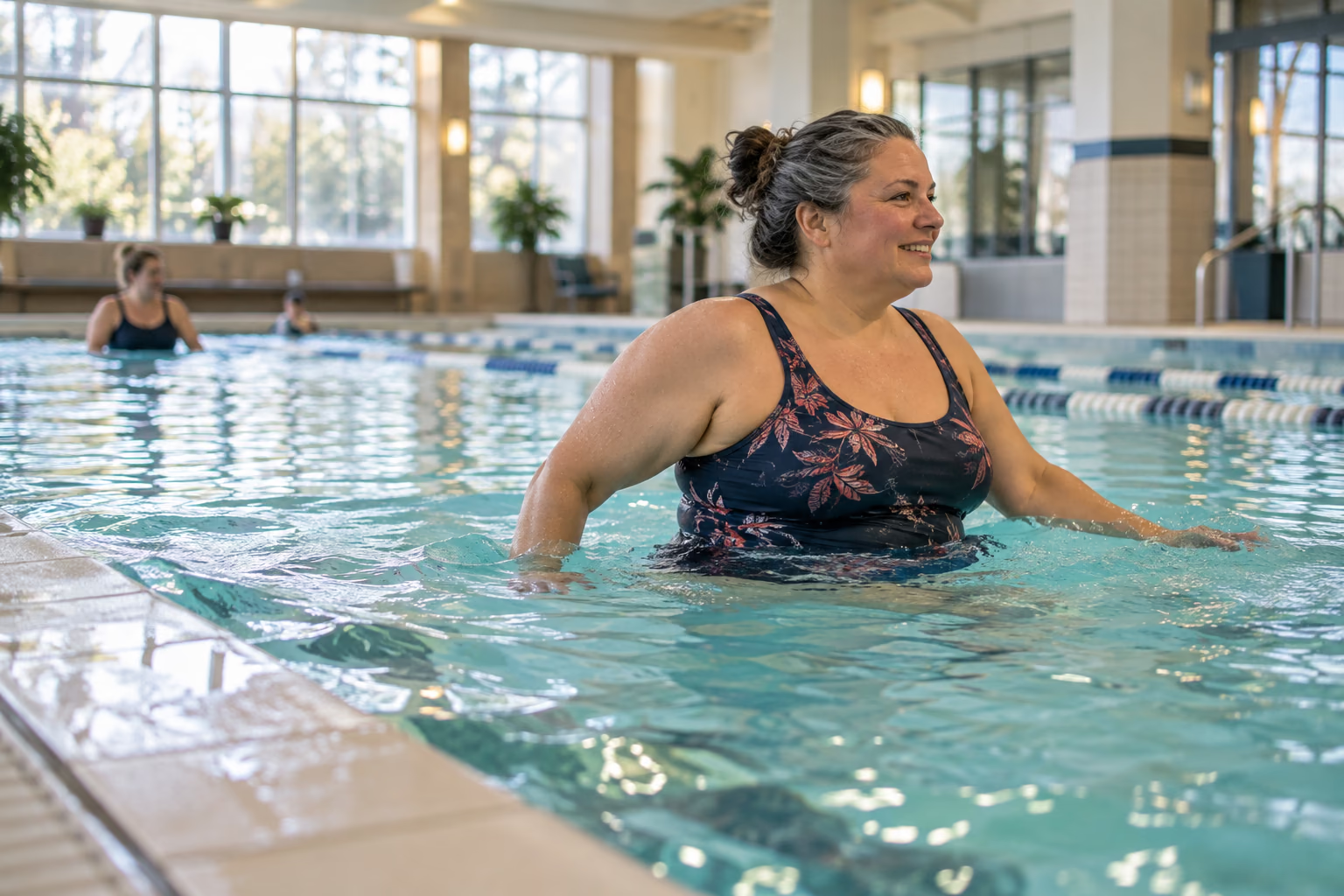
Pool walking and water aerobics use the water to support part of your body weight. They can be attractive when land-based movement feels difficult, and aquatic exercise is one of the options included in the osteoarthritis guideline. Access, water confidence, pool temperature, and safe entry and exit are equally real parts of the decision. [4] [1]
An elliptical keeps the feet in contact with the pedals and avoids the landing impact of jogging. It still requires balance and a repeated hip-and-knee pattern, so use the rails, a low resistance, and a comfortable stride at first. If the fixed path irritates a joint, the machine is not “better” just because it is labeled low impact.
Chair-based aerobics can keep a session moving when standing tolerance is limited. Federal guidance emphasizes personalized, practical ways to become more active and recommends starting with amounts that are achievable now. [5]
Use a decision filter, not a ranking
Start with four questions: Can you get into position safely? Can you move through a comfortable range? Can you control the intensity? Can you repeat the activity without a symptom pattern that keeps escalating? A “yes” to all four is more useful than a generic list of calorie estimates.
- Choose cycling when you want precise control over resistance and prefer a seated option.
- Choose the pool when buoyancy makes movement more comfortable and you have safe, reliable access.
- Choose an elliptical when standing and balance are comfortable but you want to avoid running impact.
- Choose a chair-based routine when standing tolerance, balance, or access makes the other options impractical.
- Choose a supervised setting when setup, confidence, balance, or symptom interpretation is the main barrier. [4]
There is no need to commit to one mode forever. A pool session may work on one day and a short bike ride on another. The goal is a repeatable pattern, not loyalty to a machine.
Start with a small dose and build one thing at a time
CDC says five- or ten-minute sessions can count and advises starting slowly when beginning or increasing activity. HHS similarly emphasizes that small changes add up. A first session can simply be five easy minutes after a comfortable warm-up, followed by a check of how the joint feels later that day and the next morning. [1] [6]
When that starting dose is repeatable, change one variable. Add a few minutes before adding more resistance, speed, and extra days all at once. This is not a medical formula; it is a way to make cause and effect easier to observe.
For aerobic intensity, the talk test is a simple guide: at moderate intensity, you can talk but not sing; at vigorous intensity, you cannot say more than a few words without pausing for breath. Water aerobics and slower level cycling are CDC examples of moderate-intensity activity. Your relative effort may differ, so use the conversation test rather than chasing somebody else’s pace. [3]
The talk test measures breathing effort, not joint tolerance. You can be breathing comfortably while a knee dislikes the bike setup. Treat those as separate signals: lower the joint demand by changing the range, resistance, duration, or activity, even if your heart and lungs could do more.
Keep resistance work in the bigger plan
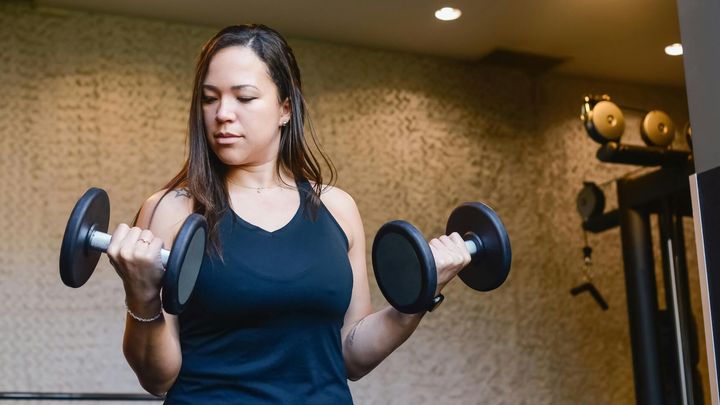
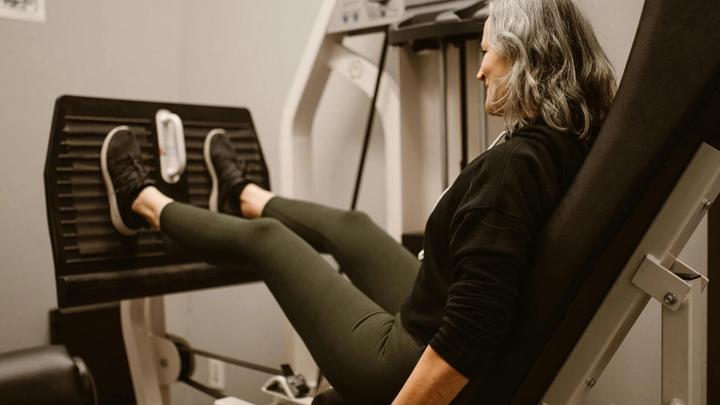
Lower-impact aerobic work can improve fitness and make movement more accessible, but it does not replace muscle-strengthening activity. Federal Move Your Way guidance recommends muscle-strengthening work on at least two days a week for adults who are able. A clinician or physical therapist can help adapt exercises around joint symptoms. [6]
For a separate, beginner-focused strength framework, read our guide to weight lifting on GLP-1 medicines. You do not need to turn every bike or pool session into a strength workout.
Know when modification is not enough
Some temporary stiffness or mild discomfort can happen when you begin a new activity, but the trend matters. CDC advises contacting a health care provider when pain does not improve over time or when symptoms are severe. Do not use “no pain, no gain” as a rule for a painful joint. [1]
Pause the session and seek prompt medical guidance for a new injury, sharp or constant pain, pain that changes how you walk, a large increase in swelling, a joint that is hot or red, chest pain, fainting, or severe shortness of breath. This article cannot determine the cause. A physical therapist can also help evaluate movement, fit equipment, and build an individualized progression when you are unsure where to start. [1]
If access is the obstacle, ask about community pools, arthritis-appropriate group programs, recumbent equipment, or a home chair routine. CDC notes that effective programs can be offered in community and remote formats. The most sophisticated plan has no benefit if transportation, cost, fear of falling, or an inaccessible facility keeps it from happening. [2]
Frequently Asked Questions
Is swimming always the best exercise for bad knees?
Can cycling still bother my knees?
Yes. Low impact does not mean symptom-free. Seat height, resistance, range of motion, session length, and the underlying reason for pain can all matter. Reduce the demand and get help with setup or symptom evaluation if discomfort persists.
Do I need to exercise for 30 minutes at once?
When can a physical therapist help?
A physical therapist can be useful when pain, balance, uncertainty about movement, or equipment setup makes it hard to begin. The osteoarthritis guideline notes that supervised exercise tends to produce better outcomes than unsupervised exercise, while CDC recommends individualized advice when symptoms are severe or do not improve. [4] [1]
Build the version you can repeat
A joint-friendly plan is not the easiest plan or the hardest plan. It is the version that respects your current symptoms, gives you control over intensity, and still leaves room to progress. Test one option at a small dose, notice the later response, and adjust one variable at a time. If pain is severe, changing, or persistent, make the next step a clinical conversation—not a tougher workout.
References
- Centers for Disease Control and Prevention. About Physical Activity and Arthritis. Accessed September 30, 2026.
- Centers for Disease Control and Prevention. Talking to Patients About Self-Management. Accessed September 30, 2026.
- Centers for Disease Control and Prevention. How to Measure Physical Activity Intensity. Accessed September 30, 2026.
- American College of Rheumatology and Arthritis Foundation. 2019 American College of Rheumatology/Arthritis Foundation Guideline for the Management of Osteoarthritis of the Hand, Hip, and Knee. Accessed September 30, 2026.
- Office of Disease Prevention and Health Promotion, U.S. Department of Health and Human Services. Physical Activity Guidelines Questions & Answers. Accessed September 30, 2026.
- Office of Disease Prevention and Health Promotion, U.S. Department of Health and Human Services. Move Your Way. Accessed September 30, 2026.